Improving soil quality to reduce lameness problems
Lameness is a fast-growing problem on dairy farms. Foot and leg problems have become the third most common pathology after mastitis and infertility. Foot health and production performance are linked in dairy cows. An animal with foot injuries or a limp will move less to eat and drink. Its immune status will be deficient. As a result, the cow won't fully express her production potential.
Players in the breeding world are mobilizing to contain lameness problems, with, among other things, the development of preventive trimming and the inclusion of foot health in breeding stock indexing. Thus, since 2014 and the launch of the Génosanté program, breeding organizations have included health indexes in their criteria for choosing future breeding stock. These genetic health indexes combine information on the risk of acetonemia, reproduction, udder health and foot health. Their aim is to propose more resistant breeding stock to improve the health of cows and thus enhance their technical and economic performance. The foot health index is based on seven diseases: infectious diseases (interdigital dermatitis, slug, fourchet) and non-infectious diseases (diffuse bleeding, circumscribed bleeding, opening of the white line, sole ulcer).
A better description of foot injuries to combat them more effectively
Genomics enables us to select the most interesting breeding stock by reading their genome. When we add a new criterion, such as foot health, we need to make the link between the genome and the expression of this trait. This is what has been done through Parabov, a scientific project initiated and financed by France Génétique Elevage, which has made it possible to draw up a reference system for collecting foot lesion data. Carried out on 1,2458 cattle, this survey of foot lesions has a dual purpose: to provide breeders with a lesion assessment of their herd (listing the number and type of lesions to know what to prioritize for action), and to collect information for selection purposes by making the link between phenotype - in this case, foot problems - and animal genotyping.
Evaluating the impact of a soil change
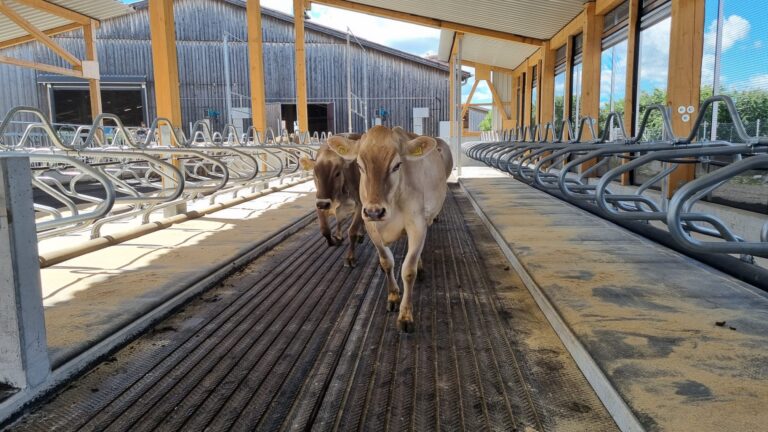
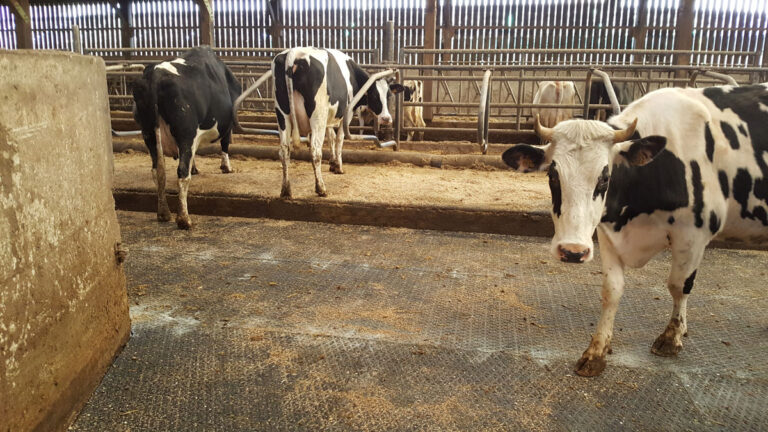
For animals that spend most of their time in buildings, the type of floor and the risk of lesions are linked. In a straw-covered area, there will be more bleeding and cherry blight. In a system of cubicles and slurry, there will be more problems with digitis dermatitis. To assess the benefits of a change of floor, lesions on the forequarters and hindquarters of 141 cows were analyzed using the Parabov methodology. Between the two parages used to observe these lesions, a number of Magellan carpet were installed in the traffic lane. On second trimming, 80% of lesions were found to have healed, but 8.6% had worsened. More specifically, 80% of the lesions were healing due to digitis dermatitis or Mortellaro's disease. The presence of lesions due to Mortellaro's disease increased from 30 to 18%. The number of diffuse bleime lesions fell from 30% to 15%.
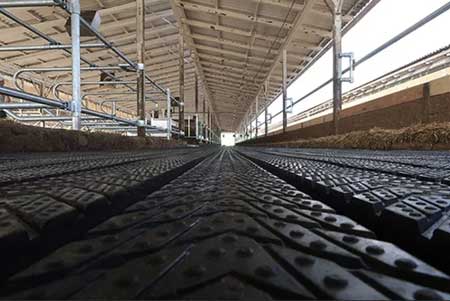
With a draining rubber mat, such as Magellan carpet, As a result, excrement is more easily evacuated. Dry, clean hooves are less likely to develop disease. What's more, the grooves facilitate the removal of small stones, which are thrown up in the excrement. These stones can cause wounds on the sole. Wounds which, although small, are a gateway for germs.
Covering part of the stall's concrete with Magellan soft mats reduces the risk of injury and lameness. This contributes to the good health, well-being and full production of your herd.